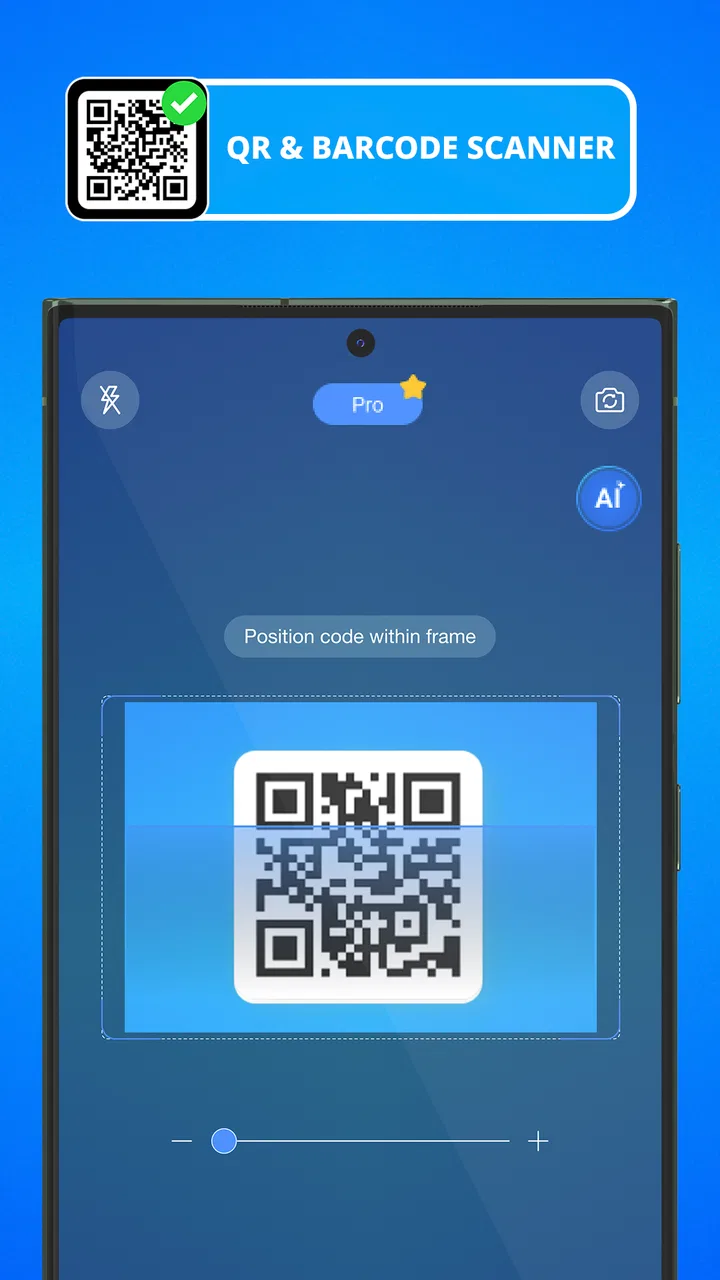
QR Scanner - QR Code Scanner
- 4.0
- Rating
- 50.00M
- Installs
- Free
- Price

 Analysis by App-foxy
I tend to forget how often QR codes appear until I leave home: a restaurant menu, a parcel label, a payment counter, a museum sign, or a login screen on another device. QR Scanner - QR Code Scanner is built for those quick moments. It is a free productivity app from Red Sky Labs that focuses on reading QR codes and barcodes, with code generation included as part of the package. I found its appeal less in novelty than in removing a small everyday annoyance: opening the camera, hoping it recognizes the pattern, and then trying again when the angle or lighting is poor.
The app has a 4.1 average from roughly 130 thousand ratings, with more than 50 million installs. That level of adoption makes sense because the job is familiar and easy to understand. It is rated for Everyone, runs on Android versions starting with 7.0, and its current release is 3.4.2. I would describe it as a practical utility rather than an app I would keep open for long periods. Its value appears when a code is in front of me and I want a direct result without turning the task into a project.
How QR Scanner behaves when connectivity becomes part of the task
When a scan leads to an online page, I treat recognition and connectivity as two separate steps: the code may read correctly even if the destination loads slowly. I’ll look at how that distinction affects the next decision, including when to wait, retry, or switch to a connection that can finish the task. That small checkpoint can save an unnecessary second scan and make the handoff clearer.
You May Also Like

 Blood Strike: 2.5 Anniversary
Blood Strike’s Loadouts Turn Every Drop Into a Tactical Gamble
A close look at Blood Strike’s custom loadouts: how fast access to signature weapons reshapes its battle royale rhythm, rewards preparation, and narrows the gap between fights.

 Pandora - Music & Podcasts
Pandora’s Music Is Easy to Start, but Harder to Recover
Pandora’s strength is its low-effort path from a seed to a station. Its weak spot is how much confidence it asks you to place in connection, setup, and quiet recovery.

 8 Ball Pool
 Is Built on Rivalries, Rematches, and Routine
A close look at the rivalries, rematches, shared routines, and unanswered safety questions that turn a quick pool match into a persistent mobile community.

 Samsung Music
’s Quiet Strength Is Playing What You Already Own
Its reach comes less from spectacle than from dependable access to a personal library. That simplicity is both the app’s strongest retention engine and its ceiling.

 AccuWeather: Weather Radar
AccuWeather Review: A Quick, Clear Forecast for Everyday Decisions
For everyday plans, the best forecast is the one you can understand quickly. AccuWeather makes rain timing, radar, and local conditions easy to act on, with a few trade-offs.

 Hill Climb Racing
Why Hill Climb Racing Still Turns Crashes Into One More Run
A tiny car, a bumpy hill and one more upgrade: Hill Climb Racing keeps resurfacing because its simple chaos makes every near-miss feel personal.
More From Our News Desk
View All News


Scanning is quick, but the next step may depend on the network
The important distinction with any scanner is between recognizing a code and using what that code contains. A camera can identify a pattern, but the destination might be a web page, an online menu, a sign-in service, a ticketing system, or another connected resource. In those situations, the scanner can get me to the doorway, while the phone still needs a working connection to complete the visit. That separation is easy to overlook when an app is described simply as a QR reader.
In my experience, the best workflow is to treat the scan result as a checkpoint. I first check whether the displayed destination makes sense before opening it. A printed code on a café table should lead somewhere related to the café, not to an unexpected domain or a strangely worded page. This small pause is more useful than blindly tapping the first result, especially when the surrounding environment is busy and I am trying to move quickly.
Connectivity also changes how satisfying the app feels. In a strong-signal area, the process can seem almost instant: point the phone, let the pattern settle, and continue. In a basement, crowded venue, underground station, or rural area, the scan itself may be fine while the destination stalls. That is not necessarily a scanner failure, but it is a practical limitation users should understand. The app can identify the code; it cannot make an unavailable website respond.
A realistic everyday use case
Imagine I am collecting a parcel and the counter displays a QR code for tracking. I scan it, inspect the result, and open the tracking page. If the page loads, I can confirm the parcel status without typing a long reference number. If the signal is weak, I still know the code was read correctly because the result appeared, even though the tracking service may take longer to load. That distinction helps me decide whether to rescan or simply wait for the connection.
Another useful situation is switching between screens. A code shown on a laptop, tablet, or second phone is often easier to scan than to retype. I can use the Android device as the bridge, then continue the process in the browser or service that the code points toward. This is particularly convenient for setup pages and sign-in flows, although the usefulness depends on the service behind the code rather than on the scanner alone.
Why the mobile context matters
QR scanning is rarely done at a desk with perfect lighting. I am more likely to use it while standing, carrying a bag, holding a receipt, or trying not to block a queue. That makes the camera view and the time needed to recognize the code more important than a long feature list. A focused scanner is easier to understand in those moments than a general productivity suite filled with tools I do not need.
Screen brightness, reflections, and movement all affect the practical experience. A glossy display can reflect overhead lights, while a small printed code may require me to move the phone rather than simply bringing it closer. I get better results by keeping the phone reasonably steady and changing the angle before assuming the code is unreadable. This is a simple habit, but it prevents unnecessary repeated attempts.
The app is also a sensible option for people using older Android hardware, since its minimum operating-system requirement reaches back to version 7.0. That does not guarantee identical camera performance on every device, because image quality and focus behavior vary between phones. Still, the compatibility range makes it more approachable than tools that require a recent handset. For an older spare phone used at a front desk, in a small shop, or as a household utility device, that can be a meaningful advantage.
Creating codes is more useful than it first sounds
The generator adds a second side to the app. Reading a code is the obvious task, but creating one can help when I need to share a destination without asking someone to type it. For example, I could prepare a code for a webpage, a contact detail, or another piece of information that is easier to present visually than spell out. The practical trade-off is that the generated code is only as helpful as the information behind it, and a web destination still depends on connectivity when someone scans it.
I would use the generator for temporary sharing or a simple handoff, not as a replacement for every normal communication method. A text message is often clearer when the recipient is already in a conversation with me. A QR code becomes more useful when it will be printed, displayed on another screen, or placed somewhere several people can access. Thinking about the physical context first helps avoid creating a code that looks clever but adds an unnecessary step.
What happens when a scan fails
The most common recovery mistake is repeating the same action without changing anything. If the first attempt does not work, I adjust one variable at a time: move slightly farther away, straighten the phone, reduce glare, improve the light, or make sure the entire code is inside the camera area. A code that is cropped at the edge or distorted by a sharp angle may need positioning rather than more patience.
It is also worth checking the source. If the code is printed too faintly, damaged, folded, or displayed at very low brightness, no scanner can reliably reconstruct every pattern. When the code is on another phone, increasing that screen’s brightness and avoiding reflections can help. When it is on paper, flattening the page may make a bigger difference than moving the camera closer.
After recognition, I separate three possible problems. First, the pattern may not have been identified. Second, the result may have been identified but contain an invalid or incomplete destination. Third, the destination may be valid but unreachable because the network is slow or unavailable. Treating these as separate cases prevents me from wasting time rescanning a perfectly readable code when the real issue is the website or connection.
Handling results with a little more care
A fast scanner can encourage careless tapping. I prefer to read the result before opening it, especially if the code came from a poster, an unfamiliar package, or a public surface. The purpose of the code should match the destination. If a restaurant code produces an unrelated address, or a shipping label points somewhere unexpected, I would stop and verify it through another channel.
This is not a criticism unique to this app. Any QR reader can expose the phone to whatever information the code carries. The useful habit is to see the scanner as an interpreter, not as a trust service. It tells me what is encoded; I remain responsible for deciding whether the next action is appropriate.
Using it without wasting data
Because the app may lead to connected content, data-conscious use starts with deciding whether the result needs to open immediately. If I am on a limited mobile plan, I can scan first, inspect the destination, and wait until Wi-Fi is available before loading a media-heavy page. This is especially sensible for codes used at events, where several scans in a short time can lead to pages with images, forms, or video.
There is also a difference between scanning a code for information and scanning one that triggers an account or transaction flow. For a simple label, immediate access may be harmless. For a login, payment, or personal-data form, I slow down and confirm the destination before proceeding. The scanner makes the first step faster, but speed should not remove the usual checks I would make in a browser.
When I create a code, I think about the recipient’s connection as well as my own. A code pointing to a page that requires a strong signal may be frustrating in a venue with poor reception. If the information can be written directly on the sign or shared in plain text, that may be the more dependable choice. The generator is most effective when it complements the physical setting rather than assuming every user has uninterrupted access to the internet.
How it compares with built-in camera scanning
Many phones can recognize QR codes directly through the default camera, so this app is not automatically necessary for everyone. If the built-in camera on my device already detects the codes I use and presents results clearly, adding a separate scanner may feel redundant. The strongest reason to choose a dedicated tool is convenience around scanning and the inclusion of code creation in the same place.
The comparison changes on older or inconsistent devices. A dedicated app can be easier to reach than searching through camera modes, and its purpose is immediately clear to someone who does not want to learn a manufacturer-specific interface. On the other hand, people who prefer the fewest installed apps may reasonably stay with the camera they already trust.
I would also distinguish it from broad productivity applications. Those suites may combine scanning with document capture, cloud storage, editing, and collaboration, which is useful for office workflows but excessive for a quick code lookup. QR Scanner - QR Code Scanner feels more appropriate when the recurring need is specifically reading or making codes, not managing a complete document pipeline.
Who will appreciate it, and who should skip it
I think it suits students, travelers, shoppers, small-business staff, and anyone who regularly encounters printed or screen-based codes. It is also a reasonable utility for a family device because the Everyone rating and straightforward purpose make the learning curve small. The free entry point makes it easy to try before deciding whether the workflow fits.
I would be less enthusiastic about recommending it to someone who only scans a code once every few months and already has a reliable camera shortcut. That person may gain little from another app. I would also suggest a more specialized document tool to someone whose real need is scanning multi-page paperwork, extracting text, organizing receipts, or annotating files. A QR utility should not be judged as though it were a full document-management system.
The app includes in-app purchases ranging from about five dollars to around forty dollars per item. That makes it important to look at the actual purchase screen before paying and decide whether the extra value matches the way I use the app. For occasional scans, the free experience may be enough; for heavier use, I would consider what the paid options change rather than assuming payment is required simply because those options exist.
My practical verdict on the connected experience
After using it as a focused Android utility, I see QR Scanner - QR Code Scanner as a convenient bridge between physical objects and online actions. Its biggest strength is clarity: I know why I opened it, what I am trying to scan, and what to do with the result. The generator broadens its usefulness beyond one-way reading, while support for devices beginning with Android 7.0 keeps it relevant to older phones.
Its limitations are tied to the job itself. A scanner cannot repair a damaged print, replace a poor camera, or make a remote webpage load in a dead zone. The app also does not remove the need to inspect unfamiliar destinations, manage mobile data thoughtfully, or choose a different tool when the task is really document capture. Those are not reasons to dismiss it; they are boundaries that make the recommendation more honest.
For me, the deciding question is frequency. If QR codes are part of my normal day, a dedicated reader and generator can save small amounts of time repeatedly, especially when the default camera is awkward or inconsistent. If I rarely use them, the built-in option may be sufficient. Either way, I would keep the network distinction in mind: the scan can succeed even when the connected action cannot. Used with that expectation, this free productivity app from Red Sky Labs is a sensible, approachable choice for everyday code tasks.
FAQs for QR Scanner - QR Code Scanner
01What features does the QR Scanner - QR Code Scanner app offer?
The QR Scanner - QR Code Scanner app provides a range of features including scanning QR codes and barcodes, generating QR codes, and saving scan history for easy access. It supports multiple code formats and offers quick access to URLs, text, and other embedded data. The user-friendly design ensures smooth operation for all users.
02Is the QR Scanner app free to use, or does it have any in-app purchases?
The QR Scanner - QR Code Scanner app is free to download and use. However, it may offer in-app purchases for additional features or an ad-free experience. These purchases are optional and designed to enhance the overall functionality of the app for users who need more advanced options.
03How secure is the QR Scanner app in terms of privacy and data protection?
The QR Scanner - QR Code Scanner app prioritizes user privacy and data protection. Information scanned or generated is not stored on external servers, ensuring that your data remains private. The app only requests essential permissions, such as camera access, to perform its functions effectively.
04Can the QR Scanner app scan all types of barcodes and QR codes?
Yes, the QR Scanner - QR Code Scanner app can scan a wide variety of QR codes and barcodes, including URLs, text, contact info, calendar events, and more. It supports popular barcode formats like EAN, UPC, and ISBN, making it versatile for various scanning needs across different industries.
05What devices are compatible with the QR Scanner app?
The QR Scanner - QR Code Scanner app is compatible with both Android and iOS devices. It supports a wide range of smartphones and tablets, ensuring that users can access its features regardless of their device model. Regular updates ensure compatibility with the latest operating systems.
Pros
- Fast and efficient scanning process.
- Supports multiple barcode formats.
- Minimal permissions required.
- User-friendly interface design.
- Offline scanning capability.
Cons
- Contains in-app ads.
- Limited customization options.
- No batch scanning feature.
- Occasional slow app launch.
- No built-in history export.

QR Scanner - QR Code Scanner
Gallery